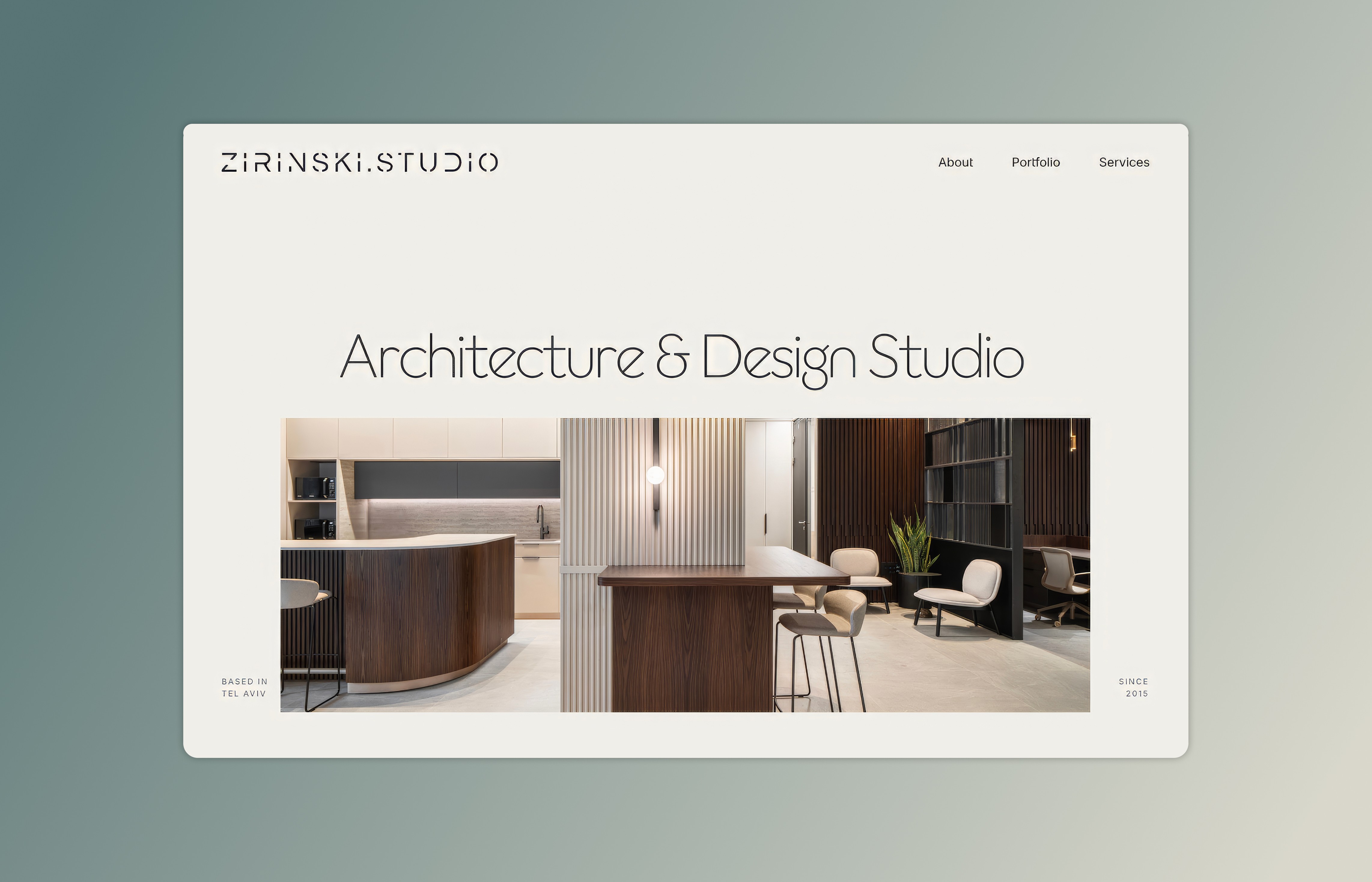
Zirinski Studio
Role
Lead UI/UX Designer
YEAR
2022
Focus
Boutique Architecture Website · UI/UX &
YEAR
2022
Client
Zirinski Studio
YEAR
2022
Year
2026
YEAR
2022
Translating an architectural practice's material intelligence into a digital presence
Zirinski Studio is a Tel Aviv-based architecture and interior design practice with a decade of built work across residences, commercial spaces, and cultural venues — tied together by material precision, calm spatial logic, and considered detail. The work was strong. The digital presence wasn't keeping up with it.
CHALLENGE — Strong built work, invisible online
Architecture's real product is spatial and tactile — neither translates automatically to a screen. Without intentional design, a portfolio becomes a grid of images with captions, flattening work that deserves more. Zirinski had no website that reflected their voice, creating friction with developers and institutional clients doing research before reaching out. The absence wasn't neutral — it was costing them credibility at the exact moment first impressions were being formed.
GOALS — Design a digital space that thinks the way the studio thinks
The brief wasn't to make things prettier. It was to build a website that communicated the studio's architectural sensibility — their attention to proportion, their preference for restraint over decoration, their ability to work across typologies without losing a consistent point of view. The site also needed to function as a credible professional touchpoint for high-value clients — developers, private residential clients, and institutions — not just a portfolio gallery.
PROCESS — Starting with the studio's design language, not web conventions
I started by mapping how Zirinski's target clients actually research and evaluate an architecture firm before making contact. The insight was straightforward: these clients aren't browsing for inspiration. They're verifying capability and character. The site architecture had to answer two questions quickly — what kind of work does this studio do, and what is it like to work with them — before asking anything of the visitor.
I used architectural drawing as the structural reference point: thin lines, organised grids, generous negative space, and typographic hierarchy that reads like plan notation. The services section was structured to mirror the studio's actual process — from site research through post-occupancy support — giving clients a clear picture of how engagement works before they reach out. Every decision was tested against one question: does this feel like the built work, or like a website about the built work?
DESIGN DECISIONS — Letting the photography and architecture do the work
The most important decision was what not to do. No decorative overlays, no competing transitions, no credibility badges the work didn't need. The grid gives each project room to breathe, alternating full-bleed horizontals with tighter crops for rhythm without predictability. The palette mirrors the studio's own material choices: concrete, oak, off-white plaster. Navigation was kept deliberately minimal — the site assumes a visitor who wants to look, not be guided.
The contact section was written and structured as part of the design, not left as a form. It communicates how the studio works — direct client relationships, builder partnerships, 3–6 month sprints — so that by the time someone reaches out, they already understand the engagement model. That reduces friction on both sides.
IMPACT — A website the studio is proud to send
The site launched and is live. It gives Zirinski a digital presence that matches the ambition of the built work — communicating who they are, what they make, and how they work, without unnecessary noise. Built in Framer, structured to scale as the project portfolio grows.Tools: Figma · UX Research · Wireframing · UI Design · Responsive Design · Framer
Explore Live Website → Here